Bismillah, alhamdulillah.
Metal birds soaring in the sky,
Featureless and droning on high,
As an afterthought they discharge their burden,
To the earth with death laden,
Can you hear the sound as they fall?
Past the buildings rising tall,
Onto brother and sister they hurtle,
Gifts wrapped in shiny metal,
Can you hear the sound as they fall?
Was it a scream or a cry in a blackened mall?
Their blood paints road and rail,
As bodies turn ghastly pale,
Can you hear the sound as they fall?
Drowned out by jaguars screaming their call,
Collateral is the name,
Warriors charging or children chanting, it`s all the same,
Can you hear the sound as they fall?
Perhaps a few words hidden and small,
In a maze of media, reports scatter,
Ten or a hundred does it matter?
Can you hear the sound as they fall?
Silence! They command in every hall,
Tears and cries are solely theirs,
Multiplied into a world of nightmares,
Can you hear the sound as they fall?
Is there only silence as we reach the wall?
Voices drowned and downed,
Among scattered ashes on the ground.
Can you hear the sound as they fall?
Is there any that will call?
Or lift a hand,
And make a stand?
On behalf of the silent ones (2005).
Saturday, 6 December 2008

Tuesday, 2 December 2008
Poem - Clocks on Walls
Bismillah, alhamdulillah
Clocks tick quietly on walls,
Waiting as His decree falls,
Eyes shed tears,
Hearts beat between hopes and fears.
Minds running through a maze,
Seeking light through the haze,
Reflections we begin to see,
As we learn what is empathy.
To Our Lord Most High and Merciful,
Supplications rise hopeful,
For our blessed Prophet we first pray,
Now understanding comes like the first break of day.
In every face of life,
He stands a guide for a world with tests rife,
Was it not his son Ibrahim?
A source of tears on a face so pristine.
O Allah on your blessed Prophet`s face,
We ask Your blessings and peace to grace,
Yesterday patience was knowledge,
Today in the practical world for it we forage.
To our Lord, Most High,
We turn, never questioning `Why?`
Gratitude we learn through His design,
Through it the fortuitous see the divine.
To beautiful hearts praying to the Knower of the Unseen,
May the angels bless your efforts with their aameen,
From destiny to destiny we flee,
Our hearts tipped with hope of our Lord`s Mercy.
Inspired by by the struggle of a small one (2005).
Sunday, 30 November 2008
Living and studying in Egypt
Bismillah, alhamdulillah.
This is a rather long post, it is an archive version of some old Egypt posts that some may still find useful. They are dated 2004/5 so some changes are to be expected. I never got a chance to write about health, visas and attitudes.
A brief word on health: most pharmacists are doctors and the first point of call for people in Egypt. Sadly polypharmacy comes easily to doctors in Egypt. Avoid the government hospitals for any major problems (operations etc.) my experience was very poor. Two hospitals that I had a good and very good experience with respectively were with the American Hospital and Cleopatra. Note you need to have place a hefty deposit up-front usually around 10-20 thousand Egyptian pounds on admission. They do accept credit/debit cards.
An even briefer word on visas, renewal of visas is possible at the Home Ministry or known as the Mugammah, it is somewhere in the city centre, near the American University of Cairo and a stones throw from the British Airways office. There is a nice bookstore in the American University of Cairo and is worthwhile visiting at least once for dictionaries and modern Arabic literature.
A final addendum on attitude. Everyone seems to have a different experience in Egypt, but foreigners, once recognised as so, are usually targeted as fountains of money and exploitation is the general rule of thumb. The attitude problem is unfortunately accentuated when the foreigners are black, sadly reflecting quite a racist under current amongst the general public. Personally I came away with a very positive impression of Egypt and its people but on talking to many other fellow travellers found this was not the majority experience.
The following sections had been covered and have been included in this post further down
Taxi!
Soaring temperatures in the middle of July
Expenses in Egypt (Part 1) Money
Expenses in Egypt (Part 2) Study
Expenses in Egypt (Part 3) Types of Accommodation
Expenses in Egypt (Part 4) Infrastructure
Expenses in Egypt (Part 5) Rental and Equipment Prices
Expenses in Egypt (Part 6) Bawwabs and Fix-it men
Expenses in Egypt (Part 7) Safety Culture
Expenses in Egypt (Part 8) Transport & Communication
Expenses in Egypt (Part 9) Daily Living Expenses
Wednesday, 26 November 2008
Driving in Saudi Arabia - Roundabouts and gaps
Bismillah, alhamdulillah.
According to the Wikipedia: "roundabouts are statistically safer than both traffic circles and traditional intersections", they are supposed to have 40% fewer collisions, 80% fewer injuries and 90% fewer fatalities compared with intersections they replaced. It will not come as a surprise that roundabouts gained popularity post the 1960s when British traffic engineers assessed their safety compared to intersections.
Translating these findings traffic engineers in Saudi Arabia have introduced these ideas onto roads in Jeddah and other major cities. Whether the safety record of roundabouts in Saudi compare well to the safety of roundabouts in other countries is highly debatable.
The picture below shows a sign indicating to whom preference should be given. In English it clearly reads 'PRIORITY FOR CARS INSIDE THE ROUNDABOUT', though the Arabic version of the signs says priority is for cars which are بداخل 'in' or it could be understood as 'entering' the roundabout. This may be one of the reasons contributing to the confusion at roundabouts.
[caption id="" align="alignnone" width="286" caption="A possibly confusing sign in Arabic at a rondabout"]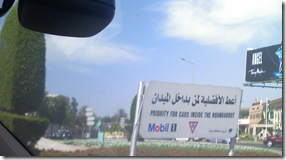 [/caption]
A typical approach to a roundabout in Saudi is to speed up and play a game of brinkmanship. The usual approach speed for a roundabout is a minimum speed of 60 km/hr with the average being around 80 km/hr. Drivers entering the roundabout assume they have priority and zoom straight on.
It does not take rocket science to work out that the result is a mess of weaving cars, near misses and accidents. Though it may seem illogical the received wisdom of drivers in general is to be as aggressive as possible at roundabouts and to play a high stakes-hit brakes late policy. This usually results in some heart stopping moments but seems to add to the general thrill of driving in Saudi Arabia. The tactic of going slow and obeying the rules is generally counterproductive and more likely to results in an accident.
On the bright side roundabouts provide an outlet for artistic expression. Various roundabouts are adorned with giant geometrical structures or everyday objects. A sort of modern art. The word for roundabout is دوار dawwar though official signs use the word ميدان maidaan which is best translated as square. In keeping with Islamic norms statues are not found at such roundabouts, instead geometrical and other forms of valid Islamic artistic expression are given life, though some leave you wondering what exactly is going on. As in the picture below of a large roundabout on 'Malik Road', this is a large roundabout with what looks like a set of sails in the middle.
[caption id="" align="alignnone" width="244" caption="The sails of a ship on a roundabout"]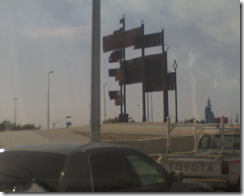 [/caption]
If your over 30 you may remember a cartoon called Wacky Races, well driving in Saudi Arabia is quite a bit like that. The concept of lanes as discussed in the previous post does not exist. The golden rule is testosterone driven and involves trying to take advatnage of any gap no matter how small or dangerous that lies ahead. Here is one common undertaking manoeuvre special as demonstrated by the driver of a white Humvee.
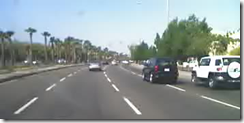
A white Humvee notices a small gap to squeeze through on the inside lane
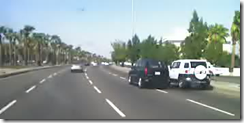
The Humvee decides to increase the efficiency of lane usage as both cars share the inner lane
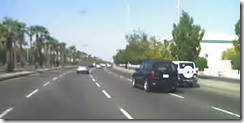
The black four wheel drive is forced aside as the Humvee pulls past
Given this general attitude when driving and the knowledge that side impacts pose greater danger to occupants than rear and front collisions, it is a reasonable policy to use the car as a defensive sheild. Imagine you are a Formula 1 driver and make sure you have plugged all gaps sufficiently well when driving, if not do not be surprised if someone is trying to squeeze through.
According to the Wikipedia: "roundabouts are statistically safer than both traffic circles and traditional intersections", they are supposed to have 40% fewer collisions, 80% fewer injuries and 90% fewer fatalities compared with intersections they replaced. It will not come as a surprise that roundabouts gained popularity post the 1960s when British traffic engineers assessed their safety compared to intersections.
Translating these findings traffic engineers in Saudi Arabia have introduced these ideas onto roads in Jeddah and other major cities. Whether the safety record of roundabouts in Saudi compare well to the safety of roundabouts in other countries is highly debatable.
The picture below shows a sign indicating to whom preference should be given. In English it clearly reads 'PRIORITY FOR CARS INSIDE THE ROUNDABOUT', though the Arabic version of the signs says priority is for cars which are بداخل 'in' or it could be understood as 'entering' the roundabout. This may be one of the reasons contributing to the confusion at roundabouts.
[caption id="" align="alignnone" width="286" caption="A possibly confusing sign in Arabic at a rondabout"]
 [/caption]
A typical approach to a roundabout in Saudi is to speed up and play a game of brinkmanship. The usual approach speed for a roundabout is a minimum speed of 60 km/hr with the average being around 80 km/hr. Drivers entering the roundabout assume they have priority and zoom straight on.
It does not take rocket science to work out that the result is a mess of weaving cars, near misses and accidents. Though it may seem illogical the received wisdom of drivers in general is to be as aggressive as possible at roundabouts and to play a high stakes-hit brakes late policy. This usually results in some heart stopping moments but seems to add to the general thrill of driving in Saudi Arabia. The tactic of going slow and obeying the rules is generally counterproductive and more likely to results in an accident.
On the bright side roundabouts provide an outlet for artistic expression. Various roundabouts are adorned with giant geometrical structures or everyday objects. A sort of modern art. The word for roundabout is دوار dawwar though official signs use the word ميدان maidaan which is best translated as square. In keeping with Islamic norms statues are not found at such roundabouts, instead geometrical and other forms of valid Islamic artistic expression are given life, though some leave you wondering what exactly is going on. As in the picture below of a large roundabout on 'Malik Road', this is a large roundabout with what looks like a set of sails in the middle.
[caption id="" align="alignnone" width="244" caption="The sails of a ship on a roundabout"]
 [/caption]
If your over 30 you may remember a cartoon called Wacky Races, well driving in Saudi Arabia is quite a bit like that. The concept of lanes as discussed in the previous post does not exist. The golden rule is testosterone driven and involves trying to take advatnage of any gap no matter how small or dangerous that lies ahead. Here is one common undertaking manoeuvre special as demonstrated by the driver of a white Humvee.

A white Humvee notices a small gap to squeeze through on the inside lane

The Humvee decides to increase the efficiency of lane usage as both cars share the inner lane

The black four wheel drive is forced aside as the Humvee pulls past
Given this general attitude when driving and the knowledge that side impacts pose greater danger to occupants than rear and front collisions, it is a reasonable policy to use the car as a defensive sheild. Imagine you are a Formula 1 driver and make sure you have plugged all gaps sufficiently well when driving, if not do not be surprised if someone is trying to squeeze through.
Wednesday, 19 November 2008
Driving in Saudi Arabia - Lanes
Within the first few hours once the new comer to Saudi Arabia has circumnavigated the various barriers to entering the country S/he will usually be greeted with a friend, company car or a taxi to ferry him from the airport to their residence. This is where the literal ‘crash’ course in driving begins. The fast journey with the weaving through queues of cars and skipping into the lane the exists between lanes is the visitors first impression. As the days pass and precariously weave themselves together into a greater tapestry a deeper understanding of driving in Saudi Arabia begins to dawn. I thought I would pen down all the various observations that have come to mind as the months have melded together.
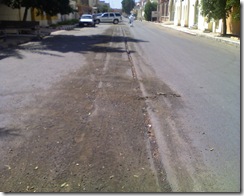 The first thing one has to realise when driving is that the various lane markings that may or may not appear on various road surfaces are an after thought and should not be followed strictly. Strictly following a lane increases your chances of having a collision. The faulty assumption is that the other drivers on the road follow the lane markings. The key to driving on the various roads is to keep one’s peripheral vision trained on the bonnet of the car on your side and its proximity to your door. Keep this distance a constant and watch out for rapid manouvres especially near slowing traffic. Perhaps it is the slowing traffic though I am not sure this is the only factor, certain drivers are clearly mesmerised by the road ahead and think they are driving a snake rather than a car and attempt to slither through the traffic.
In general ignore the lane markings and aim to keep the distance between your car and the one next to it constant. On big roads this is easiest to do on the outside or fast lane. On roads within the city it is best to stick to the middle of the road. The advantage of doing this is soon realised within a few days of driving around. Usually in countries where driving rules are better followed feeder roads joining a main road have a give way sign and cars slow down or stop and wait for the main road to be clear before joining. Here it is quite common practice for cars to swing onto the main road with little regard for what is coming down the main road. It is is assumed that the inside lane (furthest away from the other side) is always empty. Sticking like a good driver to the slow inside lane will increase your chances dramatically of being hit sooner or later by a car.
The outside lane, is also a bit of a headache within the cities. Most of the large cities have a one way system, with the occasional ‘U’ turns which allow cars to change lanes. When cars wish to change their direction they use these U turns to turn around, unfortunately nobody seems to have realised that the cars entering the U turn are in the outside or fast lane of the large roads. As you are merrily driving down you may suddenly notice that the large queue of cars in front of you are actually stationery and not moving. Be prepared to hit the brakes though not too sharply as drivers tend not to observe the car in front that carefully.
One of the often used ‘cheat sheet’ methods at a ‘U’ turn is to come on the middle lane upto the ‘U’ past the long queue of cars trying to turn and then take a left into the ‘U’ turn, watch out out for this maneouvre when driving in the middle lane.
On smaller roads where the roads are not one way, the going and coming lanes are further blurred and it is not an uncommon sight to see a car venturing down the ‘wrong’ side of the road. The best policy in these situations is to slow down rather than choose the wrong lane and allow the approaching car to whizz around you. Most drivers in these parts tend to think they can whizz around any barriers like a fly zooming around someone’s head, unfortunately when both drivers heading in opposite directions have this mentality it tends to lead to mid-road collisions.
Other lanes that you may not realise but do exist especially on the various highways are the service lane on the inside and the patch of desert on the outside. Both are used quite often as traffic density increases especially on the way to popular destinations such as Makkah. If you happen to look in the rear view mirror and see a cloud of dust coming up on the outside lane, that is usually someone driving faster than everyone in the outer lane but along the desert track. Other places where an extra lane is squeezed out is the small gap between the outside lane and the crash barrier on the Jeddah-Makkah highway. It is a daily sight to find people flashing away at the car in front and overtaking squeezing through gap between the cars in the outside lane and the crash barrier. In such conditions miscalculations are not infrequent and it is best to avoid this outer lane when traffic is moving at high speed, in particular on the Jeddah Makkah highway.
Next post, God willing, will be on the art of round abouts.
Lane markings
 The first thing one has to realise when driving is that the various lane markings that may or may not appear on various road surfaces are an after thought and should not be followed strictly. Strictly following a lane increases your chances of having a collision. The faulty assumption is that the other drivers on the road follow the lane markings. The key to driving on the various roads is to keep one’s peripheral vision trained on the bonnet of the car on your side and its proximity to your door. Keep this distance a constant and watch out for rapid manouvres especially near slowing traffic. Perhaps it is the slowing traffic though I am not sure this is the only factor, certain drivers are clearly mesmerised by the road ahead and think they are driving a snake rather than a car and attempt to slither through the traffic.
In general ignore the lane markings and aim to keep the distance between your car and the one next to it constant. On big roads this is easiest to do on the outside or fast lane. On roads within the city it is best to stick to the middle of the road. The advantage of doing this is soon realised within a few days of driving around. Usually in countries where driving rules are better followed feeder roads joining a main road have a give way sign and cars slow down or stop and wait for the main road to be clear before joining. Here it is quite common practice for cars to swing onto the main road with little regard for what is coming down the main road. It is is assumed that the inside lane (furthest away from the other side) is always empty. Sticking like a good driver to the slow inside lane will increase your chances dramatically of being hit sooner or later by a car.
The outside lane, is also a bit of a headache within the cities. Most of the large cities have a one way system, with the occasional ‘U’ turns which allow cars to change lanes. When cars wish to change their direction they use these U turns to turn around, unfortunately nobody seems to have realised that the cars entering the U turn are in the outside or fast lane of the large roads. As you are merrily driving down you may suddenly notice that the large queue of cars in front of you are actually stationery and not moving. Be prepared to hit the brakes though not too sharply as drivers tend not to observe the car in front that carefully.
One of the often used ‘cheat sheet’ methods at a ‘U’ turn is to come on the middle lane upto the ‘U’ past the long queue of cars trying to turn and then take a left into the ‘U’ turn, watch out out for this maneouvre when driving in the middle lane.
On smaller roads where the roads are not one way, the going and coming lanes are further blurred and it is not an uncommon sight to see a car venturing down the ‘wrong’ side of the road. The best policy in these situations is to slow down rather than choose the wrong lane and allow the approaching car to whizz around you. Most drivers in these parts tend to think they can whizz around any barriers like a fly zooming around someone’s head, unfortunately when both drivers heading in opposite directions have this mentality it tends to lead to mid-road collisions.
Other lanes that you may not realise but do exist especially on the various highways are the service lane on the inside and the patch of desert on the outside. Both are used quite often as traffic density increases especially on the way to popular destinations such as Makkah. If you happen to look in the rear view mirror and see a cloud of dust coming up on the outside lane, that is usually someone driving faster than everyone in the outer lane but along the desert track. Other places where an extra lane is squeezed out is the small gap between the outside lane and the crash barrier on the Jeddah-Makkah highway. It is a daily sight to find people flashing away at the car in front and overtaking squeezing through gap between the cars in the outside lane and the crash barrier. In such conditions miscalculations are not infrequent and it is best to avoid this outer lane when traffic is moving at high speed, in particular on the Jeddah Makkah highway.
Next post, God willing, will be on the art of round abouts.
Monday, 10 November 2008
Knowledge v Experience
Bismillah, alhamdulillah
"Knowledge is knowing how things work, experience is knowing how things don't work."
"Knowledge is knowing how things work, experience is knowing how things don't work."
Sunday, 9 November 2008
Poem - Kings
Bismillah, alhamdulillah
Like the smile of a man dying and old
Teeth brazen and bold
Pompous fountain relating stories
Reliving an age gone of past glories
The rest of the building stands by
Humbled by the blackness slowly rising high
Lost in the shards of infinity
Our hearts in their vicinity
A dull beat against the cold
Our hearts stained and rusted since old
Lamps draped in black gowns
Mortar boards and two towns
The mythology self fulfilling
The masses ever following
Devoid of schism a panacea they paint
The truth reduced to a tapestry faint
But never shall the twain
Abide with each other in refrain
Live and let live their call
But far short of Him they fall
O sweet Granada and Spain
Do you witness this tragedy and pain?
Little do we learn
From history and its return.
A poem after visiting King's College, Cambridge (1989)
Subscribe to:
Posts (Atom)